

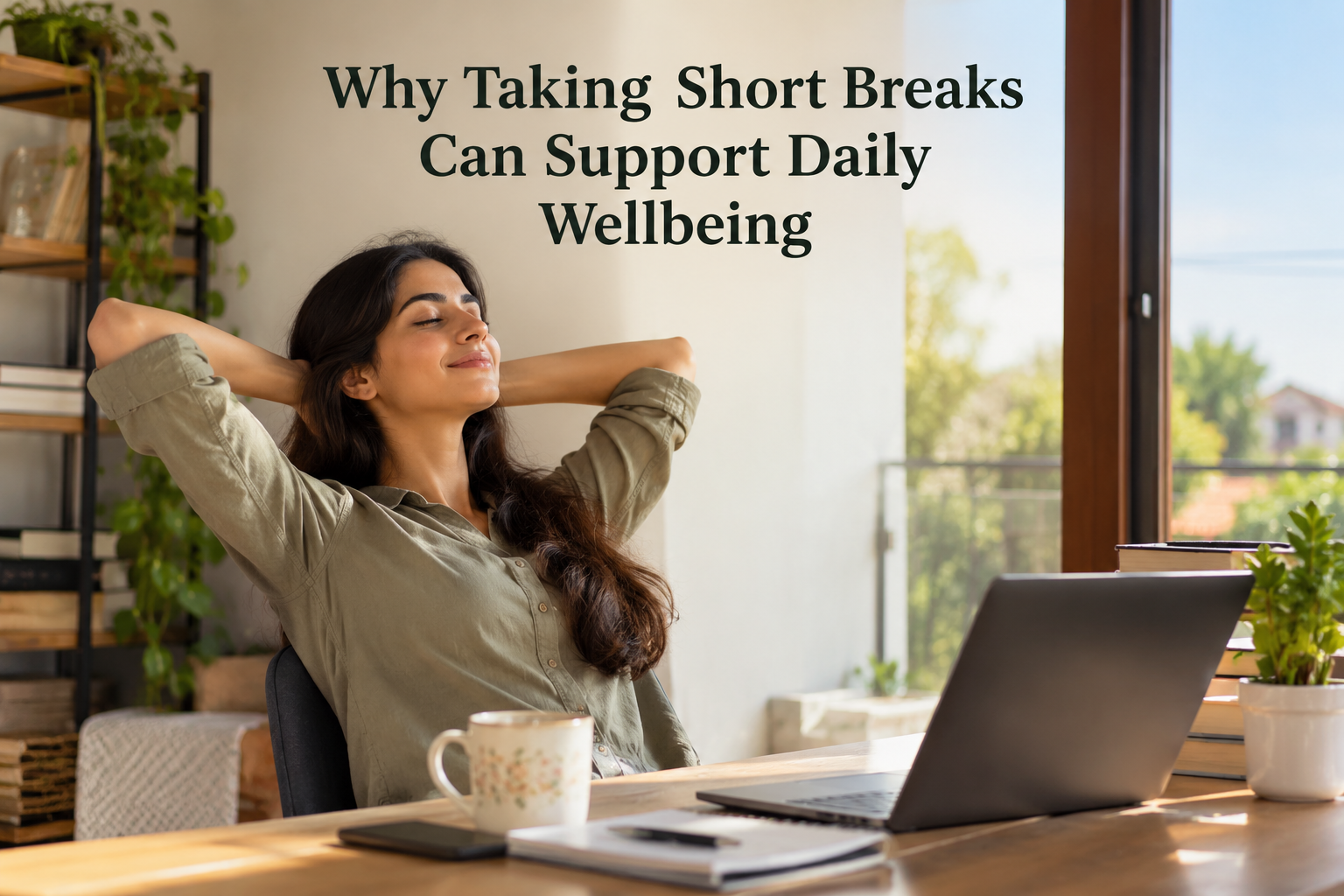
Modern life often encourages us to stay busy for as long as possible. Many people move from one task to another without giving themselves enough time to rest. We answer messages, complete office work, study, manage household responsibilities, and deal with many small decisions throughout the day. While being productive is important, working continuously without rest can leave the mind and body feeling tired.
This is why taking short breaks can support daily wellbeing. A short break does not need to take a large amount of time. Even a few quiet minutes can give the mind an opportunity to slow down, reset, and prepare for the next task.
From what I have learned through reading about productivity, healthy routines, and personal wellbeing, breaks are not simply empty moments. They can be useful parts of a balanced day. When used properly, short breaks may support concentration, comfort, energy, and emotional balance.
Why Short Breaks Matter
The human mind is not designed to stay focused at the same level for many hours without rest. Concentration naturally changes throughout the day. After working on the same activity for a long period, attention may begin to fall.
You may notice yourself reading the same sentence again, making simple mistakes, becoming impatient, or feeling mentally tired. These signs can mean that your mind needs a brief change of activity.
Taking a short break gives you an opportunity to interrupt this mental tiredness.
You do not need to stop working for an hour. Sometimes five or ten minutes away from a demanding task can help you return with a clearer mind.
The purpose of a short break is not to avoid responsibility. It is to create a healthier rhythm between effort and recovery.
Short Breaks Can Refresh the Mind
Mental tiredness can develop slowly.
At the beginning of the day, a task may feel easy. After several hours of work, however, the same task may require much more effort. This happens because concentration uses mental energy.
A short break gives your attention somewhere else to go.
You might stand near a window, drink water, walk around the room, or simply close your eyes for a moment. These simple activities allow your brain to move away from constant concentration.
When you return to your work, you may notice that your thoughts feel more organized.
I think this is one of the biggest benefits of taking short breaks. They create a small space between tasks where the mind can recover.
Breaks May Support Better Concentration
Many people believe that working continuously is the best way to complete more tasks. In reality, long periods of work can sometimes reduce concentration.
When attention becomes weak, people may continue working but accomplish less.
They may spend twenty minutes on something that normally takes ten minutes. They may also miss small details because their mind is no longer fully involved.
Short breaks can help prevent this pattern.
Instead of waiting until you feel completely exhausted, you can take small breaks during the day.
For example, after completing an important task, you can leave your desk for a few minutes. Stretch your body, breathe slowly, or walk through the room.
Then return to your work.
This simple habit can make long working periods feel more manageable.
Short Breaks Can Reduce Physical Discomfort
Daily wellbeing is not only about the mind. The body also needs movement and variety.
People who work on computers often sit in the same position for long periods. Over time, this may create stiffness or discomfort in the neck, shoulders, back, wrists, or legs.
Short breaks provide an opportunity to change position.
You can stand up, move your shoulders, gently stretch your arms, or walk for a few minutes.
Even small movements can help you feel less stiff.
This is especially important for people who spend most of their day sitting.
Our bodies are made for movement. Remaining in one position for many hours can feel uncomfortable, even if the chair and desk are comfortable.
Taking regular movement breaks can make the working day feel easier on the body.
Breaks Can Support Emotional Balance
A busy day can include many different emotions.
You may feel pressure from work, frustration from a difficult task, worry about deadlines, or irritation after an uncomfortable conversation.
When we move immediately from one stressful situation to another, these feelings can build up.
A short break can create emotional space.
You might step outside, drink a glass of water, breathe slowly, or sit quietly.
During this time, you are giving yourself a chance to move away from the situation for a few minutes.
You may return feeling calmer and more prepared to respond thoughtfully.
This does not mean every problem disappears after a short break. It simply means that a little distance can sometimes help you think more clearly.
Short Breaks Can Improve Daily Energy
Energy naturally rises and falls throughout the day.
Most people do not feel equally energetic from morning until night. There may be times when you feel highly focused and other times when your energy becomes lower.
Working without breaks can make low energy feel even stronger.
A short break can provide a small reset.
Walking around, washing your face, getting fresh air, or having some water may help you feel more awake.
The goal is not to force yourself to feel energetic all the time. Instead, it is to give your body and mind regular opportunities to recover.
I find the idea simple but useful. Rather than seeing breaks as wasted time, we can see them as small moments that help maintain energy throughout the day.
A Short Walk Can Be a Useful Break
One of the easiest ways to take a break is to walk.
You do not need a long walk or a special location.
You can walk around your home, office, garden, hallway, or nearby outdoor area.
Walking changes your physical position and gives your eyes something different to see.
It also moves your attention away from your current task.
If you work indoors for many hours, a few minutes outside can feel especially refreshing.
Natural light, fresh air, trees, and open space can provide a pleasant change from screens and indoor environments.
A short walk can therefore support both physical and mental wellbeing.
Give Your Eyes a Rest
Screens have become a major part of daily life.
Many people use computers for work and then spend additional time looking at phones, tablets, or televisions.
During a short break, it can be helpful to look away from screens.
Instead of immediately checking your phone, look across the room or outside a window.
This gives your eyes a different visual distance.
It also prevents your break from becoming another period of digital stimulation.
One habit I personally find sensible is separating some breaks from technology. If every break becomes an opportunity to scroll through social media, the mind may not feel truly rested.
Sometimes a quiet break can be more refreshing than a digital one.
Use Breaks to Drink Water
Busy people often forget simple habits such as drinking enough water.
Short breaks can become useful reminders.
When you stop working for a few minutes, you can drink water and check how you are feeling.
This creates a natural connection between breaks and healthy daily routines.
Keeping a glass or bottle of water nearby can make this easier.
You do not need complicated wellness routines. Small habits repeated during the day can be valuable.
Stretch During Your Break
Stretching can be another simple way to use short breaks.
After sitting for a long time, stand up and gently move your body.
You might stretch your arms, rotate your shoulders, straighten your back, or move your legs.
The movements do not need to be difficult.
The purpose is simply to change position and release some stiffness.
A few minutes of gentle movement can feel surprisingly refreshing after long periods of sitting.
For people who work from home, stretching can easily become part of the daily routine.
Breaks Can Support Better Decisions
Mental tiredness can affect decision making.
When people are exhausted, they may become impatient or choose the fastest option rather than thinking carefully.
This can happen during work, study, shopping, conversations, or planning.
A short break can create enough distance to review a situation more calmly.
For example, if you are struggling with a difficult decision, you may not need to continue thinking about it constantly.
Walk away for a few minutes.
Do something simple.
Then return.
Sometimes the answer becomes clearer when you stop forcing yourself to find it.
Short Breaks Can Help With Creative Thinking
Creative ideas do not always appear while we are actively searching for them.
Sometimes they appear while walking, resting, washing dishes, or doing something completely unrelated.
This is another reason short breaks can be useful.
When the mind moves away from focused work, it may begin connecting ideas differently.
Writers, designers, students, business owners, and other professionals may benefit from this change of mental activity.
If you feel stuck on a problem, continuing to stare at it may not always help.
A short break might give your mind the space it needs to approach the problem differently.
How Often Should You Take a Break?
There is no single break schedule that works perfectly for everyone.
Different jobs and responsibilities require different levels of concentration.
Someone doing physical work may need different breaks from someone working at a computer.
A practical approach is to notice your own energy and attention.
If you start losing concentration, feeling stiff, becoming unusually frustrated, or making repeated mistakes, it may be time for a short break.
Some people prefer planned breaks.
For example, they may work for about an hour and then take a few minutes to move around.
Others prefer taking breaks after completing specific tasks.
Both approaches can work.
The most important thing is developing a pattern that feels realistic and sustainable.
Avoid Turning Short Breaks Into Long Distractions
There is an important difference between a refreshing break and a distraction.
Opening social media for five minutes can easily become thirty minutes.
Watching one short video may turn into watching many videos.
This can make it difficult to return to work.
A useful break usually has a clear beginning and ending.
You might decide to walk for five minutes, make a drink, or stretch.
Then return to your activity.
Keeping breaks simple helps you enjoy the benefit without losing too much time.
Create a Healthy Break Routine
If you want to make short breaks part of your daily wellbeing routine, start small.
Choose one or two activities that help you feel refreshed.
You might walk around the room, stretch, drink water, look outside, practice calm breathing, or sit quietly.
Use these activities during natural pauses in your day.
For example, take a break after completing an assignment, finishing a meeting, answering important emails, or completing a household task.
Over time, these small pauses can become part of your normal routine.
You may begin noticing that your day feels less rushed.
Simple Break Ideas for a Busy Day
There are many easy ways to take short breaks without interrupting your schedule.
You can stand near a window and look outside.
You can walk around the room.
You can drink a glass of water.
You can stretch your shoulders and arms.
You can sit quietly for a few minutes.
You can step outside for fresh air.
You can take several slow breaths.
You can organize your desk.
You can water a plant.
You can listen to a calm piece of music.
The best break is usually something simple that changes your attention and allows you to return feeling refreshed.
Short Breaks Can Support Work Life Balance
One reason modern life feels stressful is that many people remain mentally connected to work all day.
Even after finishing one task, they immediately think about the next one.
Short breaks can create small boundaries.
They remind us that the day does not need to be one continuous period of productivity.
There is room for movement, rest, reflection, and quiet moments.
This can support a healthier relationship with work and responsibility.
Productivity is useful, but wellbeing matters too.
A balanced day should include both effort and recovery.
Listen to Your Body and Mind
One of the most valuable habits is learning to recognize when you need rest.
Your body may communicate this through stiffness, tired eyes, restlessness, or low energy.
Your mind may communicate it through poor concentration, irritation, or difficulty thinking.
Instead of ignoring these signs, consider taking a short pause.
You do not need to wait until you are completely exhausted.
Small breaks taken earlier may help prevent excessive tiredness later.
Learning to notice these signals can make daily wellbeing easier to manage.
Final Thoughts
Taking short breaks can support daily wellbeing in many simple ways. They can give the mind a chance to refresh, improve concentration, reduce physical stiffness, support emotional balance, and help maintain energy throughout the day.
The important thing is to keep breaks simple and intentional.
You do not need expensive wellness programs or complicated routines. A few minutes of walking, stretching, drinking water, breathing calmly, or looking away from a screen can be enough to create a useful pause.
After reading about healthy routines and observing how energy changes throughout the day, I have come to see breaks differently. They are not necessarily signs of laziness or lost productivity. They can be practical tools for maintaining focus and balance.
A productive day should not mean working every minute.
Sometimes the best way to continue moving forward is to stop for a few moments, refresh yourself, and then begin again with a clearer mind.