

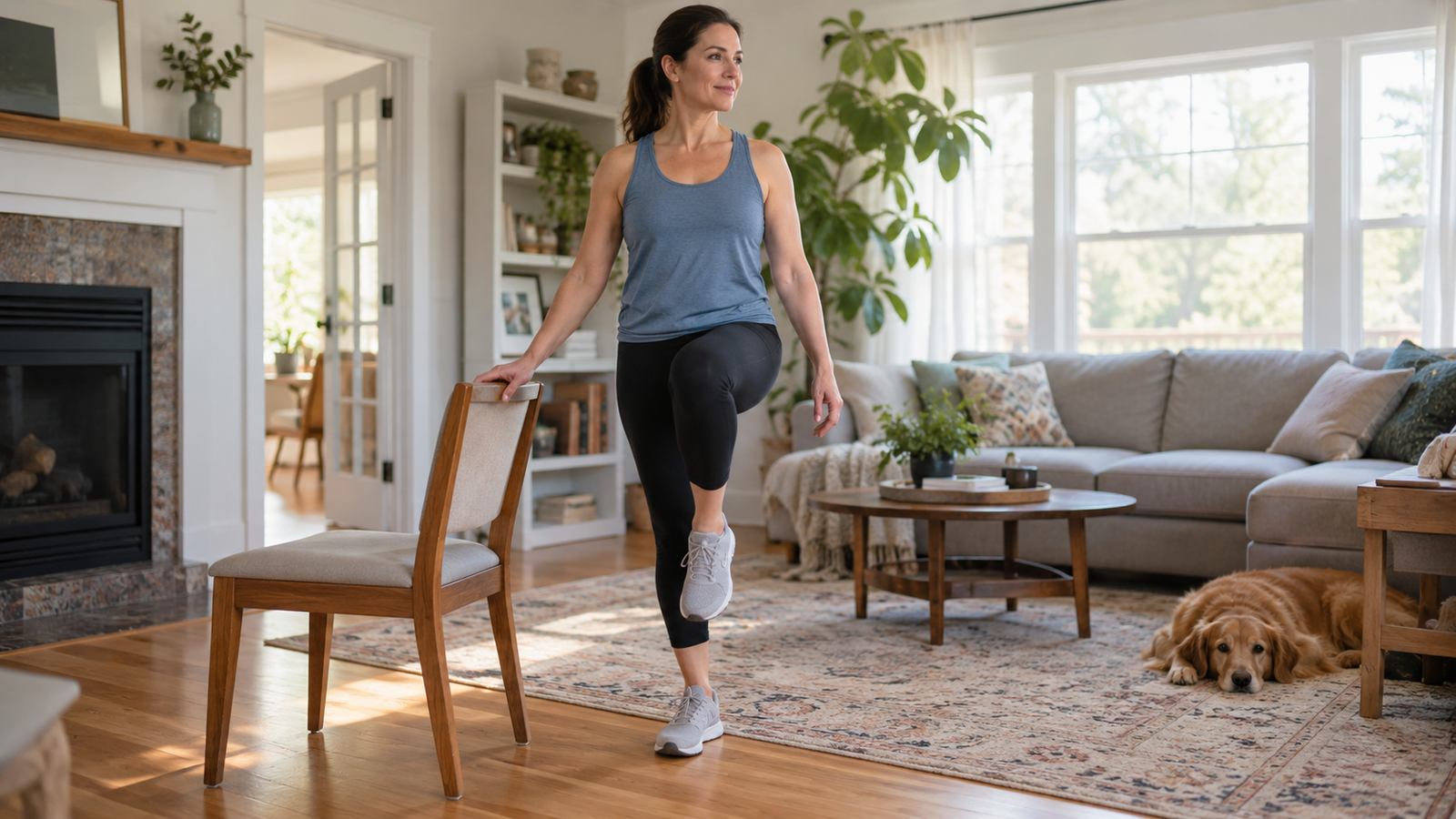
Balance is something we use every day, often without thinking about it. We need balance when we stand up from a chair, walk across a room, climb stairs, reach for something on a shelf, or step over an object on the floor. Good balance helps the body move with more control and confidence.
Many people think balance exercises are only for athletes or older adults, but that is not true. Balance training can be useful for people of many ages and fitness levels. Simple balance exercises can help improve body awareness, coordination, posture, and everyday movement.
The good thing is that you do not need special equipment or a gym membership. Many easy balance exercises can be practiced at home using a chair, wall, or clear floor space.
In this article, I will explain easy balance exercises for everyday movement, why balance matters, how to practice safely, and how you can make balance training part of your normal routine.
What Is Balance?
Balance is the ability to keep your body stable while standing, sitting, walking, or changing position.
Your body uses information from several systems to maintain balance. Your eyes help you understand where you are in relation to your surroundings. Your inner ear helps detect movement and changes in position. Your muscles and joints send information to your brain about how your body is moving.
All of these systems work together.
When your balance is good, your body can respond quickly when your position changes. For example, if you step on an uneven surface, your muscles automatically make small adjustments to help keep you upright.
Balance is not only about standing on one leg. It is also about controlling your body during normal movement.
Why Balance Is Important for Everyday Movement
Good balance can make daily activities feel easier and more comfortable.
Walking is one of the simplest examples. Every time you take a step, your body briefly shifts its weight from one side to the other. Good balance allows this movement to happen smoothly.
Balance is also important when climbing stairs. Your body must control your weight while one foot moves to the next step.
Reaching for something also requires balance. When you stretch your arm forward or upward, your center of gravity changes. Your body automatically adjusts to prevent you from losing stability.
Balance can also support better posture. When the muscles around the legs, hips, and core work together, the body can remain more stable during movement.
Benefits of Simple Balance Exercises
Regular balance exercises may support several areas of physical movement.
Better Body Control
Balance exercises encourage you to pay attention to how your body moves.
You begin to notice how your feet contact the floor, how your weight shifts, and how your muscles respond.
This improved body awareness can make everyday movement more controlled.
Improved Coordination
Balance and coordination are closely connected.
When you practice standing on one leg or walking heel to toe, your brain and muscles must work together.
With regular practice, these movements may become smoother.
Stronger Supporting Muscles
Many balance exercises activate small stabilizing muscles around the ankles, knees, hips, and core.
These muscles help support your body during movement.
Greater Confidence During Movement
When your balance improves, activities such as walking, turning, or stepping over objects may feel easier.
This can help you move with greater confidence.
Support for Everyday Mobility
Mobility is not only about flexibility.
It also includes strength, control, coordination, and balance.
Balance exercises can be an important part of maintaining comfortable everyday movement.
How Often Should You Practice Balance Exercises?
Balance exercises do not always require long training sessions.
You can practice for just a few minutes at a time.
For many people, five to ten minutes of simple balance practice several times each week can be a reasonable place to begin.
You can also include short balance exercises throughout your day.
For example, you might practice standing on one leg while waiting for water to boil or while standing near a kitchen counter.
The goal is consistency.
Small amounts of regular practice can be easier to maintain than occasional long sessions.
Important Safety Tips Before Starting
Balance exercises should always be practiced in a safe environment.
Choose a clear space where you are unlikely to trip.
Keep a strong chair, counter, or wall nearby if you need support.
Wear comfortable shoes with good grip, or practice barefoot if the floor surface is safe and comfortable.
Avoid practicing balance exercises near stairs, sharp furniture, slippery floors, or other hazards.
Move slowly and stay relaxed.
If you have a medical condition, frequent dizziness, recent injury, or serious balance problems, it is a good idea to speak with a qualified healthcare professional before starting a new exercise routine.
1. Basic Standing Balance
This is one of the simplest balance exercises and a good starting point.
Stand upright with your feet about hip width apart.
Keep your shoulders relaxed and look straight ahead.
Try to keep your weight evenly distributed between both feet.
Hold this position for about 20 to 30 seconds.
It may sound very easy, but pay attention to the small movements in your feet and ankles.
Your body constantly makes tiny adjustments to keep you stable.
As you become comfortable, try bringing your feet slightly closer together.
This makes the exercise more challenging.
2. Feet Together Balance
Stand with your feet touching or very close together.
Keep your arms relaxed by your sides.
Look at a fixed point in front of you.
Hold this position for 20 to 30 seconds.
If necessary, stand near a wall or chair.
This exercise reduces the size of your base of support, which encourages your body to work harder to maintain balance.
You can repeat the exercise two or three times.
3. Single Leg Stand
Standing on one leg is a simple and effective balance exercise.
Stand next to a chair or counter.
Place your hand lightly on the support if needed.
Slowly lift one foot a few inches from the floor.
Try to balance on the other leg.
Hold the position for five to ten seconds.
Lower the foot and repeat on the other side.
As your balance improves, you can gradually increase the time.
The goal is not to hold the position for as long as possible. The goal is to remain controlled and comfortable.
4. Heel to Toe Stand
This exercise helps challenge balance by placing the feet in a narrow position.
Stand near a wall or counter.
Place one foot directly in front of the other.
The heel of the front foot should be close to the toes of the back foot.
Keep your body upright.
Hold the position for about 10 to 20 seconds.
Then switch feet.
You may notice that one side feels easier than the other. This is normal.
Regular practice can help both sides become more comfortable.
5. Heel to Toe Walking
Once you feel comfortable with the heel to toe stand, you can try walking in the same position.
Imagine you are walking along a straight line.
Place the heel of one foot directly in front of the toes of the other foot.
Then take another step in the same way.
Take five to ten slow steps.
Turn carefully and repeat.
Keep your eyes looking forward instead of looking down at your feet constantly.
If necessary, practice near a wall.
6. Sideways Walking
Sideways movement is common in everyday life, but many people rarely practice it intentionally.
Stand with your feet together.
Take a slow step to the side with your right foot.
Then bring your left foot toward it.
Continue for several steps.
Then move in the opposite direction.
Keep your knees slightly relaxed and your upper body upright.
This exercise can help improve control around the hips and legs.
It can also make side to side movement feel more natural.
7. Marching in Place
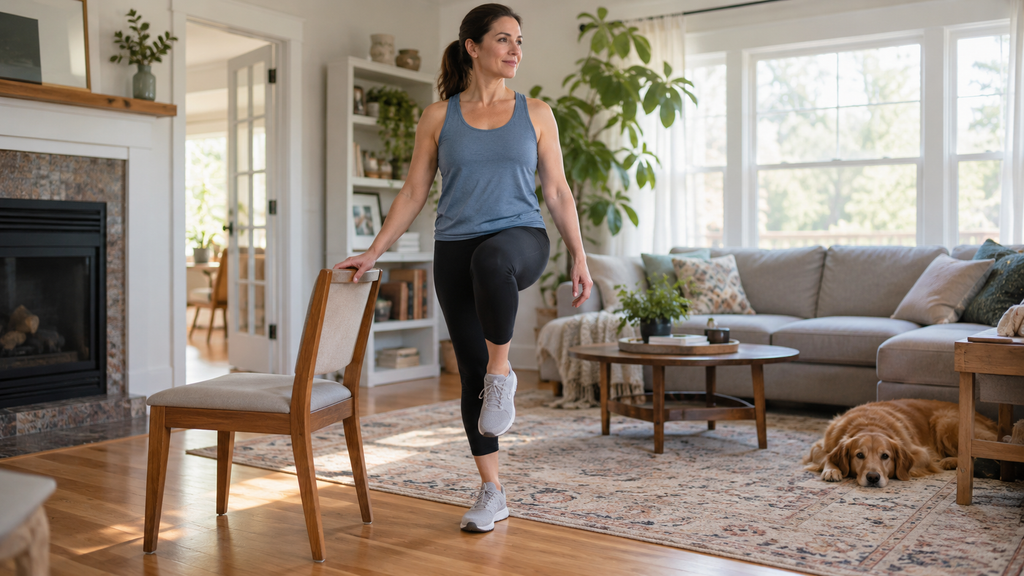
Marching in place is a simple way to combine balance and movement.
Stand near a chair if you need support.
Lift one knee slowly toward your chest.
Lower it.
Then lift the other knee.
Continue alternating sides.
Try to keep your body upright.
Avoid leaning too far to one side.
March slowly for about 20 to 30 seconds.
As your balance improves, you can lift your knees slightly higher.
8. Weight Shifting
Weight shifting teaches your body to move its center of gravity in a controlled way.
Stand with your feet about shoulder width apart.
Slowly shift your weight toward your right foot.
Keep both feet on the floor.
Hold for a moment.
Then move your weight toward your left foot.
Continue shifting slowly from side to side.
You can also practice shifting your weight forward and backward.
Keep the movement small and controlled.
This exercise can help improve awareness of how your body changes position.
9. Toe Raises
Toe raises can support ankle strength and balance.
Stand behind a chair.
Hold the chair lightly.
Slowly lift your heels from the floor so that you rise onto your toes.
Pause for a second.
Then lower your heels slowly.
Repeat eight to twelve times.
Try to avoid bouncing.
The movement should be slow and controlled.
Stronger calf and ankle muscles can support stability during walking.
10. Heel Raises
This exercise focuses on the muscles at the front of the lower legs.
Stand near a chair or wall.
Keep your heels on the floor.
Lift your toes upward.
Pause briefly.
Then lower them.
Repeat eight to twelve times.
This movement may feel unusual at first, but it can help improve control around the ankles.
11. Sit to Stand
Standing up from a chair is an everyday movement that requires strength and balance.
Sit on a stable chair.
Place your feet firmly on the floor.
Lean slightly forward.
Push through your feet and stand up slowly.
Pause when you are standing.
Then slowly sit back down.
Repeat five to ten times.
If needed, use your hands for support.
As you become stronger and more comfortable, try using your hands less.
12. Step Forward and Return
This exercise practices controlled stepping.
Stand with your feet hip width apart.
Take one small step forward with your right foot.
Shift some of your weight onto the front foot.
Then step back to the starting position.
Repeat with the left foot.
Continue alternating sides.
Keep the steps small at first.
This exercise can help prepare your body for everyday movements such as walking, stepping around obstacles, or changing direction.
13. Side Step and Return
Stand upright with your feet together.
Step to the right.
Shift your weight slightly onto the right foot.
Then bring the foot back to the center.
Repeat on the left side.
Continue slowly for several repetitions.
This exercise helps train movement in different directions.
Many daily activities require more than forward walking, so practicing side movements can be useful.
14. Backward Step Practice
Backward movement requires awareness and control.
Stand near a kitchen counter or other stable support.
Take one small step backward.
Bring your foot back to the starting position.
Repeat with the other foot.
Keep your steps small and slow.
Do not practice backward walking in a cluttered area.
This exercise can help improve control when changing direction.
15. Clock Reach Exercise
Imagine you are standing in the center of a large clock.
Stand on your left leg while keeping your right foot lightly touching the floor.
Move your right foot forward toward the imaginary 12 o’clock position.
Return to the center.
Then move it toward 3 o’clock.
Return again.
You can also move it slightly backward.
Switch legs and repeat.
Use a chair for support if needed.
This exercise challenges balance while the body moves in several directions.
16. Gentle Knee Lift With Arm Reach
Stand upright.
Slowly lift your right knee.
At the same time, raise your left arm forward.
Lower both.
Then lift your left knee and right arm.
Continue alternating.
This movement requires coordination between the upper and lower body.
Move slowly at first.
The exercise should feel smooth rather than rushed.
17. Standing With Head Turns
This exercise challenges balance by changing where you look.
Stand with your feet comfortably apart.
Keep your body still.
Slowly turn your head to the right.
Return to the center.
Then turn to the left.
Repeat several times.
You can also move your head slightly up and down.
Practice near a stable support.
Changing the position of your head can make balancing more challenging.
18. Chair Assisted Leg Lift
Stand behind a chair.
Hold the back of the chair lightly.
Lift one leg slightly to the side.
Keep your body upright.
Lower the leg slowly.
Repeat eight times.
Then switch sides.
This exercise works the muscles around the hips, which are important for walking and stability.
19. Mini Squats
Mini squats can help strengthen the legs while also challenging balance.
Stand with your feet slightly wider than hip width.
Keep a chair in front of you if necessary.
Slowly bend your knees a small amount.
Imagine you are beginning to sit down.
Keep your chest lifted.
Then return to standing.
Repeat five to ten times.
You do not need to squat deeply.
A small controlled movement is enough.
20. Slow Walking Practice
Simply slowing down your walking can become a useful balance exercise.
Choose a clear path.
Walk more slowly than usual.
Pay attention to each step.
Notice how your heel touches the floor and how your weight moves toward the front of your foot.
Slow walking requires more control than normal walking because you spend more time balancing during each step.
Try walking slowly for one or two minutes.
How to Make Balance Exercises Easier
If an exercise feels difficult, you can modify it.
Use a wall, chair, or counter for support.
Keep your feet farther apart.
Reduce the amount of time you hold a position.
Make your movements smaller.
Practice fewer repetitions.
There is no need to rush.
Balance usually improves through repeated practice.
How to Make Balance Exercises More Challenging
Once basic exercises become comfortable, you can gradually increase the difficulty.
You might reduce how much support you use from a chair.
You can hold positions slightly longer.
You can move your feet closer together.
You can also add slow arm movements while balancing.
Another option is to practice on different safe surfaces, but this should only be done if you already have good balance and the surface is stable.
The key is gradual progression.
Avoid making exercises suddenly difficult.
The Role of Core Strength in Balance
The core includes muscles around the abdomen, lower back, hips, and pelvis.
These muscles help stabilize the body.
A strong and active core can make it easier to control your position during movement.
You do not need complicated abdominal exercises to support your core.
Simple movements such as standing tall, walking, marching, and performing controlled sit to stand exercises can engage many core muscles.
Good posture can also help.
Try to keep your head, shoulders, and hips comfortably aligned during balance exercises.
The Role of Foot and Ankle Strength
Your feet and ankles play an important role in balance.
They are often the first parts of the body to respond when you start to lose stability.
Small muscles in the feet help adjust your position.
The ankle muscles help control movement when your weight shifts.
Exercises such as toe raises, heel raises, and single leg stands can help train these areas.
Comfortable shoes that fit properly can also support stable movement.
Balance Exercises During Daily Activities
You do not always need a separate workout session.
Balance practice can be included in normal activities.
For example, while standing at the kitchen counter, you can practice shifting your weight from side to side.
While waiting for your tea or coffee, you can practice a single leg stand while holding the counter.
When getting up from a chair, try standing slowly instead of using momentum.
While walking through your home, you can practice taking controlled steps.
These small habits can make balance training easier to include in your lifestyle.
Create a Simple Balance Routine
A basic routine does not need to be complicated.
You can start with five simple exercises.
Try basic standing balance for 30 seconds.
Then practice single leg standing for five to ten seconds on each side.
Do five sit to stand repetitions.
Practice heel to toe walking for several steps.
Finish with slow marching for 30 seconds.
This short routine may take only a few minutes.
You can repeat it several times each week.
As the exercises become easier, gradually increase the time or number of repetitions.
Common Mistakes to Avoid
One common mistake is trying to progress too quickly.
Balance exercises should feel challenging but manageable.
Another mistake is holding your breath.
Try to breathe normally while exercising.
Some people also look down constantly.
Looking straight ahead at a fixed point can often help improve stability.
Avoid rushing through movements.
Slow movements usually require more control and can be more useful for balance practice.
Most importantly, do not practice difficult exercises without support if you are not confident.
Safety should always come first.
Why Consistency Matters More Than Difficulty
You do not need advanced exercises to improve your balance.
Simple exercises practiced regularly can be valuable.
Balance is a skill.
Like many skills, it improves through repetition.
Practicing for five minutes several times each week may be more useful than doing one difficult session occasionally.
Choose exercises that feel comfortable enough to continue.
When something becomes easy, increase the challenge gradually.
Final Thoughts
Easy balance exercises for everyday movement can be simple, practical, and easy to include in your normal routine. You do not need expensive equipment or a large workout space.
Basic movements such as standing on one leg, marching in place, walking heel to toe, shifting your weight, rising from a chair, and practicing controlled steps can help train balance and coordination.
The most important thing is to practice safely and consistently.
Start with exercises that match your current ability. Use support when necessary. Move slowly and focus on control.
Over time, better balance can support smoother walking, easier movement, better coordination, and greater confidence during everyday activities.
Balance training does not have to feel like a difficult workout. A few minutes of simple practice can become a useful part of an active lifestyle.
By making balance exercises part of your regular routine, you can continue developing the strength, coordination, and body awareness needed for comfortable everyday movement.