

Creating a weekly activity routine does not have to be complicated. Many people believe that becoming more active means joining a gym, following a strict workout program, or spending hours exercising every day. In reality, a good weekly activity routine can be simple, flexible, and easy to fit into everyday life.
The main purpose of a weekly activity routine is to help you move regularly. It gives your week some structure while still allowing you to adjust your activities according to your schedule, energy level, and personal needs.
A simple routine can include walking, stretching, household activities, light strength exercises, outdoor movement, and recreational activities. You do not have to perform every activity at a high intensity. What matters most is building a pattern that encourages regular movement.
When I started learning more about physical activity, one idea stood out clearly. Consistency is often more useful than trying to do too much at once. A simple routine that you can follow for months is usually more practical than a difficult routine that you stop after a few days.
This article explains how to create a simple weekly activity routine that feels realistic, balanced, and easy to maintain.
Why a Weekly Activity Routine Is Helpful
Without a plan, physical activity can easily become something we keep postponing. A busy day turns into a busy week, and suddenly we realize that we have spent most of our time sitting.
A weekly routine gives movement a place in your schedule.
It does not mean that every minute of your week must be planned. Instead, it gives you a general idea of when and how you would like to be active.
For example, you may decide to walk on Monday, do a short strength session on Tuesday, stretch on Wednesday, and enjoy a longer outdoor activity during the weekend.
Having this basic structure removes some of the daily decision making.
Instead of asking yourself, “What exercise should I do today?” you already have a simple direction.
A routine can also help you notice whether your week includes enough variety. You may discover that you walk regularly but rarely stretch, or that you exercise your legs but ignore your upper body.
Planning your week makes these patterns easier to see.
Start With Your Current Lifestyle
Before creating a new routine, look at what your normal week already looks like.
Think about your work hours, family responsibilities, study time, travel, sleep, meals, and other regular commitments.
Your activity routine should fit around your real life.
If you usually have very busy mornings, planning a long morning workout may not be realistic. If your evenings are more relaxed, that may be a better time for physical activity.
Ask yourself a few simple questions.
When do I normally have free time?
Which days are usually the busiest?
Which days feel more relaxed?
Do I prefer morning, afternoon, or evening activity?
What types of movement do I actually enjoy?
Your answers can help you build a routine that works naturally with your schedule.
A successful routine should not feel like a constant fight against your lifestyle.
Keep Your Goals Simple
One common mistake is setting too many goals at the beginning.
Someone may decide to walk every day, run three times a week, lift weights four times a week, stretch every morning, and cycle every weekend.
This may sound motivating at first, but it can quickly become difficult to maintain.
Start with a few simple goals.
For example, your weekly goals could be:
Walk four days during the week.
Do two short strength sessions.
Stretch for a few minutes on most days.
Take one longer outdoor walk during the weekend.
These goals are easy to understand and easier to remember.
You can always increase your activity later after the routine becomes familiar.
Choose Activities You Enjoy
Enjoyment is one of the most important parts of a sustainable activity routine.
You are more likely to repeat an activity when you enjoy doing it.
Physical activity does not have to mean traditional exercise.
Walking through a park, gardening, dancing at home, playing with children, cycling, swimming, cleaning, hiking, and recreational sports can all involve movement.
Think about the activities that make you feel good.
Some people enjoy quiet activities such as walking alone while listening to music or a podcast.
Others enjoy social activities such as playing badminton, football, or walking with friends.
There is no single correct routine.
The best weekly activity routine is one that you are willing to continue.
Include Different Types of Movement
A balanced weekly routine can include several different types of activity.
You do not need to perform all of them every day.
Walking and general movement can support everyday activity.
Strength exercises can help maintain muscle function.
Stretching and mobility exercises can help you move comfortably.
Recreational activities can make movement enjoyable.
A simple week might include a combination of these activities rather than repeating the same exercise every day.
Variety can also prevent boredom.
If you walk every single day along the same route, you may eventually lose interest. Adding different activities can keep your routine fresh.
Make Walking the Foundation
Walking is one of the easiest activities to include in a weekly routine.
It requires little preparation and can usually be done almost anywhere.
You can walk around your neighborhood, inside a shopping area, at a local park, or during your lunch break.
Even short walks can help you become more active during the day.
You do not always need one long walking session.
For example, three ten minute walks spread throughout the day may feel easier than one thirty minute walk.
Walking can also be combined with daily tasks.
You can walk while making a phone call, walk to a nearby shop, take a short walk after dinner, or park slightly farther away from your destination.
These small opportunities can add meaningful movement to your week.
Add Two Simple Strength Days
Strength exercises do not always require gym equipment.
Many basic movements can be performed using your body weight.
Examples include chair squats, wall push ups, standing calf raises, step ups, and simple core exercises.
You can choose two days during the week for basic strength activity.
For example, Tuesday and Friday could be strength days.
A beginner session can be short.
You might perform several simple movements for ten to twenty minutes.
The purpose is not to make the session extremely difficult.
The goal is to gradually build strength while creating a regular habit.
If you use weights or resistance bands, begin with movements that you can perform comfortably and with good control.
Include Stretching and Mobility
Stretching can be a simple addition to your routine.
You can stretch after walking, after exercise, or during breaks from sitting.
Gentle mobility exercises can also help you move your joints through a comfortable range of motion.
For example, you might include shoulder circles, ankle movements, gentle hip movements, and easy stretches for the legs.
Stretching does not need to become a separate long workout.
Five or ten minutes may be enough to make it part of your routine.
Some people find it helpful to stretch in the morning, while others prefer stretching before bed.
Choose the time that feels easiest to maintain.
Use Short Activity Sessions
Many people avoid exercise because they believe they need a large amount of free time.
This can create an unnecessary barrier.
Activity sessions can be short.
A ten minute walk is still movement.
Five minutes of stretching is still movement.
A short set of bodyweight exercises is still movement.
Several short sessions throughout the week can help you build consistency.
This is especially useful for people with busy jobs, family responsibilities, or unpredictable schedules.
Instead of waiting for the perfect hour to exercise, use the small periods of time you already have.
Create a Basic Weekly Schedule
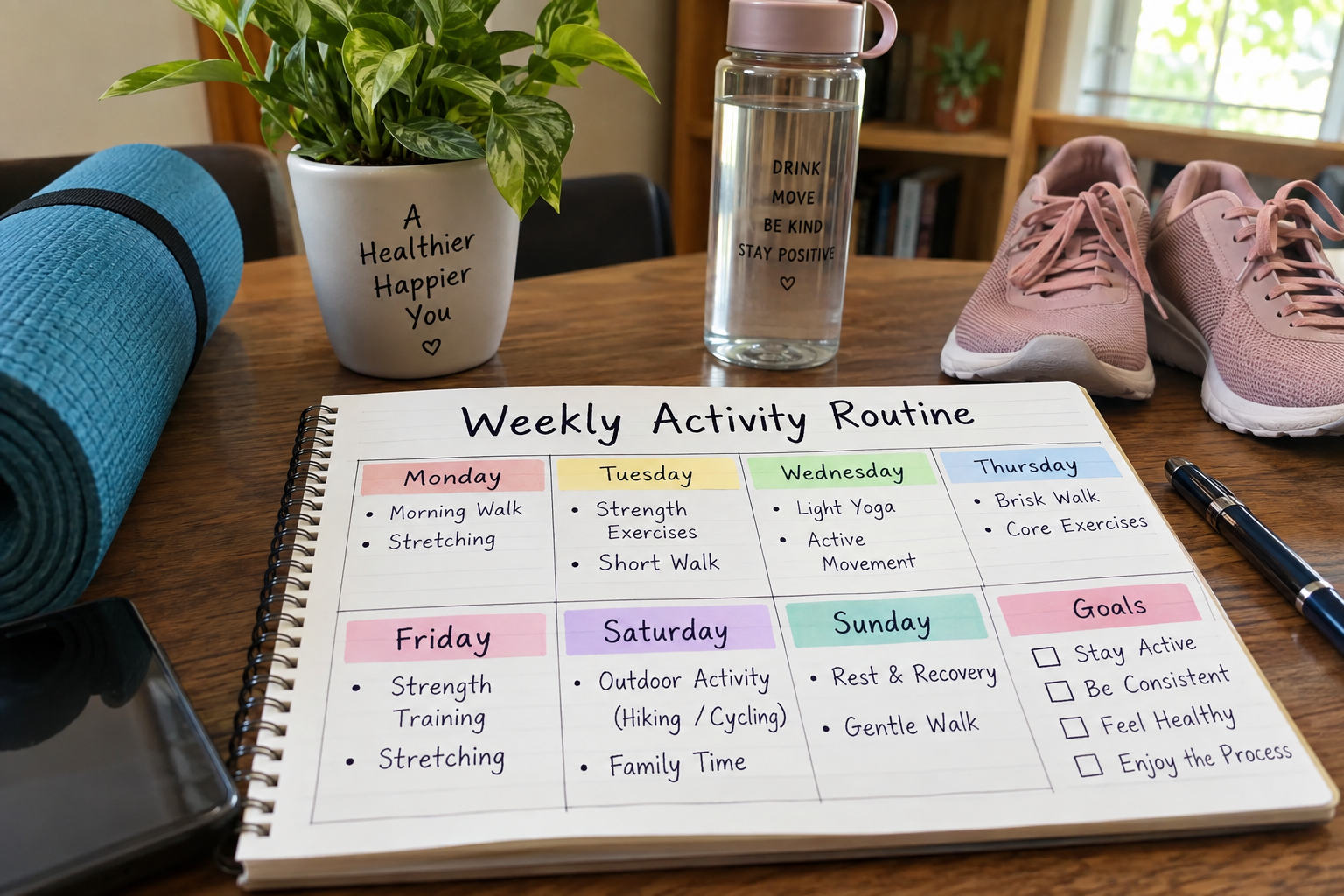
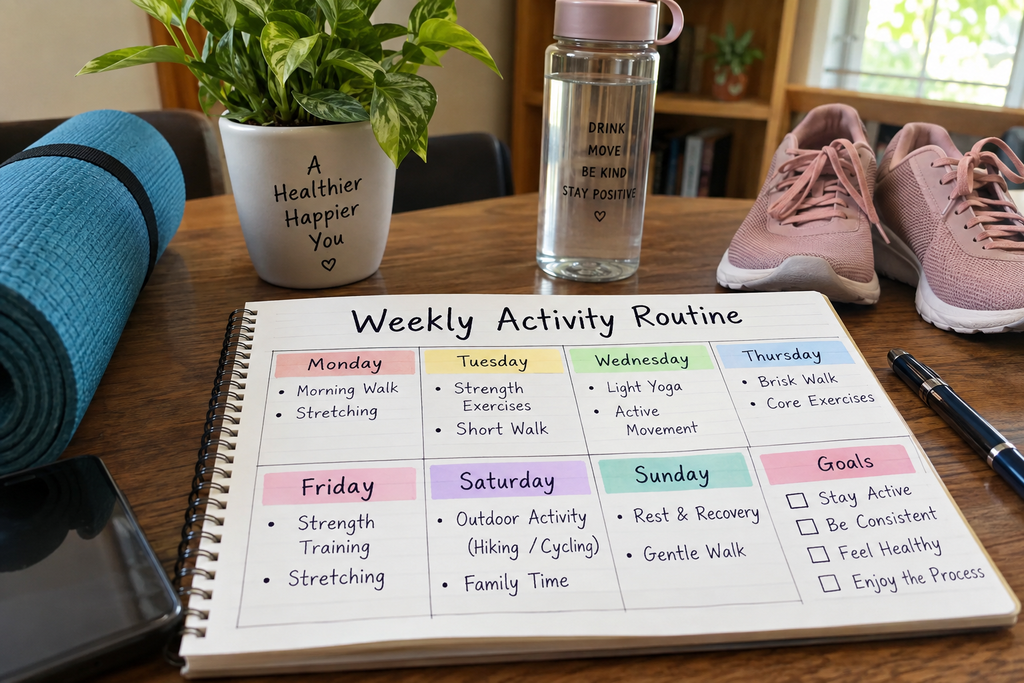
A simple weekly activity schedule might look like this.
Monday
Start the week with a comfortable twenty to thirty minute walk.
You can walk outdoors or indoors depending on the weather and your surroundings.
Finish with a few gentle stretches.
Tuesday
Do a short strength session.
Include simple movements such as squats to a chair, wall push ups, calf raises, and basic core exercises.
Keep the session manageable.
Wednesday
Make this a lighter day.
Take a relaxed walk and add a few minutes of mobility exercises.
The goal is simply to keep moving.
Thursday
Take another moderate walk.
You can change your route to make the activity more interesting.
If possible, include a few stairs or slightly faster walking periods.
Friday
Complete your second strength session of the week.
You can repeat Tuesday’s exercises or make small changes.
Focus on controlled movement rather than speed.
Saturday
Choose a longer recreational activity.
This could be a longer walk, cycling, gardening, swimming, hiking, or playing a sport.
Weekend activities can feel less like exercise when they involve something enjoyable.
Sunday
Use Sunday as a flexible recovery day.
You might take an easy walk, do gentle stretching, or simply stay lightly active through normal daily tasks.
This example is only a starting point.
Your own weekly routine may look completely different.
Use Your Environment
Your surroundings can provide many opportunities for activity.
Stairs can become a simple way to add movement.
A hallway can be used for short walking breaks.
A chair can be used for strength exercises.
A wall can be used for wall push ups.
A nearby park can become your walking area.
You do not always need special equipment.
Looking creatively at your environment can make physical activity more accessible.
Plan for Busy Days
Every week has unexpected events.
Work becomes busy.
Family responsibilities appear.
Appointments take longer than expected.
A good routine should be flexible enough to handle these situations.
Create a shorter backup version of your normal activity.
For example, if you usually walk for thirty minutes but suddenly become busy, take a ten minute walk instead.
If you cannot complete a full strength session, perform a few simple exercises for five minutes.
Doing something small keeps the habit alive.
Missing one activity session is not a problem.
The important thing is to return to your routine when possible.
Avoid the All or Nothing Mindset
One of the biggest challenges in building an activity routine is thinking that every session must be perfect.
People sometimes believe that if they cannot complete their full workout, there is no point doing anything.
This thinking can make routines difficult to maintain.
Physical activity does not need to be perfect to be useful.
A short walk is better than spending the entire day inactive simply because you did not have time for a longer walk.
A small effort can still support the habit you are trying to build.
Consistency grows when you allow your routine to be flexible.
Track Your Activity Simply
Tracking can help you understand your weekly habits.
However, you do not need a complicated system.
A small notebook or calendar may be enough.
Write down the activity you completed each day.
For example:
Monday: 25 minute walk.
Tuesday: 15 minute strength session.
Wednesday: 10 minute walk and stretching.
Thursday: 30 minute walk.
Friday: Strength session.
Saturday: Park walk with family.
Sunday: Light stretching.
Seeing your completed activities can be encouraging.
It also helps you notice patterns.
If several days repeatedly become inactive, you can think about how to adjust your schedule.
Prepare the Night Before
Small preparation can make activity easier.
If you plan to walk in the morning, place your walking shoes somewhere visible the night before.
If you plan to exercise at home, prepare your exercise space.
If you use resistance bands or light weights, keep them somewhere convenient.
Reducing small barriers can make it easier to begin.
Often the hardest part of physical activity is simply starting.
Preparation removes some of the excuses your mind may create.
Connect Activity With Existing Habits
One useful method for creating a routine is connecting movement with something you already do.
For example:
Walk after breakfast.
Stretch after brushing your teeth.
Do a few squats before taking a shower.
Take a short walk after lunch.
Stretch while watching television.
Walk after dinner.
Because the existing habit already happens regularly, it can become a reminder for your new activity.
Over time, the two actions may start to feel naturally connected.
Include Family or Friends
Physical activity can become easier and more enjoyable when other people are involved.
You might take evening walks with your family.
You could play outdoor games with children.
You might walk with a friend or neighbor.
Social activity can create motivation without making exercise feel formal.
It also provides an opportunity to spend time together while moving.
However, you do not always need company.
Some days you may prefer to exercise alone.
A good routine can include both social and personal activities.
Listen to Your Body
Your energy level will not be the same every day.
Some days you may feel energetic and ready for a longer activity.
Other days you may feel tired.
A weekly activity routine should allow some flexibility.
If your body feels unusually tired, you might choose a lighter activity.
Gentle walking or stretching can sometimes be more suitable than an intense session.
If you experience significant pain, dizziness, breathing difficulty, or another concerning symptom during exercise, stop the activity and seek appropriate medical advice.
Movement should support your wellbeing, not become a punishment.
Increase Activity Gradually
Once your weekly routine becomes comfortable, you can slowly add more activity.
For example, you might increase a twenty minute walk to twenty five minutes.
You might add another set to your strength exercises.
You could include an additional walking day.
Small increases are easier to adapt to than sudden major changes.
There is no need to rush.
A routine can grow gradually over many weeks or months.
Make Your Routine Flexible
Your routine should guide you, not control you.
If it rains on your planned outdoor walking day, walk indoors or switch the activity with another day.
If you travel, choose simple activities that can be done without equipment.
If work becomes unusually busy, shorten the session.
Flexibility helps protect the routine from normal life changes.
The goal is to continue moving, even when the exact plan changes.
Review Your Week
At the end of each week, take a few minutes to look back.
Ask yourself:
Which activities did I enjoy?
Which days were difficult?
Did the routine fit my schedule?
Was I trying to do too much?
Could any activity be made easier?
This short review can help you improve your routine.
You are not judging yourself.
You are simply learning what works.
A routine becomes more effective when it changes according to your real experience.
Focus on Long Term Consistency
Physical activity is not something that must be completed perfectly every week.
Some weeks will be more active than others.
Travel, work, family events, weather, and many other factors can change your schedule.
Think about your routine over months rather than individual days.
If you continue returning to movement, the habit becomes stronger.
This long term approach is more realistic than trying to maintain a perfect schedule forever.
Final Thoughts
Creating a simple weekly activity routine is mainly about finding practical ways to move regularly.
You do not need a complicated fitness plan or expensive equipment.
Start by looking at your current schedule. Choose a few activities you enjoy. Include walking, basic strength work, stretching, and recreational movement. Keep your sessions manageable and adjust them when life becomes busy.
A simple routine might include walking several days a week, two short strength sessions, regular stretching, and one enjoyable weekend activity.
The exact schedule is less important than consistency.
The best routine is one that fits naturally into your life and feels realistic enough to continue.
Start small.
Stay flexible.
Notice what works for you.
Over time, simple movement can become a normal part of your week rather than something you constantly have to force yourself to do.
Frequently Asked Questions
How many days a week should I be active?
You can include some form of movement on most days, but not every day needs to involve a structured workout. Walking, stretching, household tasks, and recreational activities can all contribute to an active week.
How long should each activity session be?
The length can depend on your schedule and current fitness level. Short sessions such as ten or twenty minutes can be a practical starting point.
Do I need a gym to follow a weekly activity routine?
No. Walking, bodyweight exercises, stretching, stairs, household activities, and outdoor recreation can all be done without a gym.
What if I miss a day?
Simply continue with your routine when you can. Missing one day does not erase your progress.
Should every week follow exactly the same schedule?
No. Your routine can change depending on work, family responsibilities, weather, travel, and energy levels.
What is the easiest way to start?
Choose one simple activity, such as a daily ten minute walk, and build your routine gradually from there.
SEO Keywords
How to create a simple weekly activity routine, weekly activity routine, simple exercise routine, weekly fitness plan, beginner activity routine, healthy weekly routine, easy exercise schedule, daily movement routine, simple weekly workout plan, how to stay active every week.